Showing posts with label Asian dessert. Show all posts

August 02, 2011

Sago Pudding or Gula Melaka

This is one of  Malaysian or South East Asian favourite dessert. It is really a great combination of texture and flavour. I was a bit uncertain when i first made it for my boys as they are Dutch and never tried a pudding that is like this but they loved it and wanted more!

Sago Pudding

120g dried sago pearls
1 litre of water
350ml can coconut cream
pinch of salt
150g chopped Dark Palm Sugar or Gula Melaka
2 Pandan leaves ,bruised and knotted (optional)
20ml Hot boiling water


  • Soak the dried pearl sago for at least an hour. Drain it and bring the litre water to boil and pour in the sago.
  • Boil sago over low heat and stir constantly until sago pearls turn transparent.
  • Pour the sago to a huge small hole sieve and run cold water through. This is to remove any unwanted starch.
  • Scoop the portion of your liking the mould you like. You can use any mould you wish from muffin tray or a big jelly mould. Any shapes and sizes.
  • Place the mould /moulds in the fridge.
  • Combine the chopped dark palm sugar (gula melaka) with the hot water and pandan leaves. Bring it to boil for 3-5 minutes on low heat until the sugar melts and to a nice rich syrup consistency.
  • Remove from heat, discard the pandan leaves and set in a jug to cool.
  • All the coconut cream with a pinch of salt and warm it up in a pan. When done pour in to a jug and keep it refrigerated.
  • When its time to serve, remove the sago from the mould and pour in the gula melaka syrup and topped with the coconut cream. Or guests can do it themselves so they can pour the syrup and coconut cream to their own liking!


January 18, 2011

Welcome 2011

This is the beginning of a New Year. Lots have happen in 2010 and i am hoping 2011 will be a better one for me and everyone i know.I have set some new goals and i really hope it all follow through.

Ever since the start of the New Year i have been having cravings for lots of Asian food. Food like is close to my roots South East Asia.You know food i grew up eating, things you do not find easily when you are abroad.

One that pop in my mind was Glutinous rice and it's a perfect time to try it as its also very close to Chinese New Year as there are many kinds of food with symbolic meaning in the Chinese cuisine. Since traditional Chinese attach great importance to the family values, there foods can express their best wishes for the family reunion.

So since i have some Kaya (Asian coconut jam) left and wanting to finish it i have decided to try and make a Malaysian cake or should i say Kuih/ Kueh. It is a Chinese Baba Nyonya specialty cake. Called Pulut Tai Tai or Blue Glutinous Rice Cakes. The blue color comes from a flower name Bunga Telang or Blue Pea Flower. I did not have any at hand so i use some blue food coloring. But it turned out not as dark blue as how it is but it was a nice color and really its up to you how blue you like it to look.

Pulut Tai Tai

2 cups glutinous rice - was and soak overnight or at least 4 hours before cooking
1 1/2 cup - 2 cups coconut milk
4 pandan leaves, tie leaves to a knot
1 tsp salt
2 tbsp sugar
few drop of blue food coloring

Method
  • Wash and drain the glutinous rice. Divide rice into two portions. Soak half the rice in plain water and the other in blue food coloring water.
  • Drain the glutinous rice from the water. The rice soaked in the food coloring will have been tinted blue.
  • Mix coconut milk with salt and sugar, stir to dissolve sugar.
  • Put the rice, pandan leaves and pour half the coconut milk evenly over the rice. Steam over rapidly boiling water for 10 mins. Open the lid of the steamer and fluff up the rice and mix in the balance coconut milk.Close the lid and continue steaming for another 15-20 mins until the rice is done.
  • Remove from heat and discard the pandan leaves.
  • Line a square tin with banana leaves if you do not have any cling wrap will do too.Spoon in the cooked rice,press down the rice with a large spoon.
  • Cover the top of the rice with banana leaves or cling wrap and weigh it down with a heavy object. leave to cool, cut in to pieces and serve with kaya.
  • You can also put them in shaped molds of your liking.I like to serve it slightly warm so you can warm it up in the microwave or in a steamer.


December 03, 2010

Onde Onde

This is really a favorite of most people when they try it. Because it is really a taste you will never forget it has a nice chewy texture(similiar to a Chinese/ Japanese mochi cake) and that when you bite in it a warm molten syrup filling just burst into your mouth. The coating of fresh grated coconut will be best but if not use good quality dessicated coconut will do the trick too.

This is definitely one of the most popular Asian dessert/ snack that you find around the world. In Indonesia these same sweet balls are called klepon.There are many different variety out there but the one i am sharing is the original one or in my eyes they are.

Onde Onde


Dough
½ cup glutinous rice flour
100ml coconut milk
pandan aroma pasta ( from your Asian store)


Fillings
½ cup shaved dark (Indonesian) palm sugar
(Rolled it to tiny balls so its easy to stuffed them later.)


Coating for rolling finished balls 
½ cup desiccated coconut + ¼ tsp crushed sea salt mixed into it.


  • Knead glutinous rice flour with coconut milk till a ball gathers and the dough is slightly moist.Then add in the pandan pasta and knead till incorporated. If the dough seems a little dry add a little water or coconut milk. Plastic wrap immediately to keep moist.
  • To stuff the dough, pinch a small portion of the dough, toll roughly into a ball and squash so it's about four to five mm thick. Place the palm sugar into the centre and covered, then pinch away any dough you think it is too much as you do not want it too be too doughy. Roll in palm of hands till you form a perfect ball.
  • As the balls are rolled, position them on a baking tray lined with parchment.
  • Fill a medium to large pot with boiling water and the coconut coating ready in separate bowls. Drop the balls in five to six at a time so you can manage the coating immediately after cooking. When the balls are cooked, they will float to the top. Scoop them out with a slotted spoon.
  • Tip balls into coating and roll till completely covered. Arrange attractively on a plate and serve. Store in airtight container. These are best eaten right away or the same day.

October 20, 2010

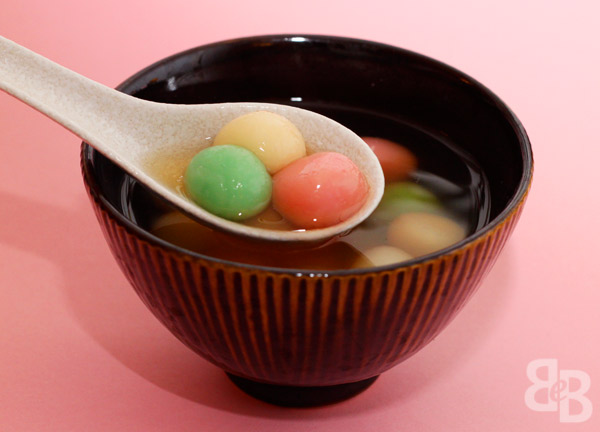
Tang Yuan (glutinous rice balls)

The weather is sure getting colder and all of a sudden i just have this craving for a childhood memory dessert of mine, eating something i love when i was young and still do now. Is known as Tang Yuan i remember eating it on special occasions only so i always eat as much as i can as after the occasion is over so is  the Tang yuan. But now adays its much easier to get them if you live in Asia.


Tang yuan is a traditional Chinese dessert which is well loved by all generations. They’re basically glutinous rice balls (either filled or unfilled) that are served in a sweet broth. They’re most popular during the winter solstice usually celebrated in December and symbolizes the day in the year where the day is the shortest. After this celebration, the Chinese believe that the days will be filled with more hours of sunlight, and therefore and increase in the amount of positive energy. In addition, eating these during the winter solstice also symbolizes becoming a year older. Besides eating these during the winter solstice, tang yuan are also made on special celebrations (such as Chinese New Year) and used as an offering to the gods. They are also served during weddings, that it is considered good luck for the bride and groom.


There are many variants of tang yuan, and as I mentioned earlier they can be either filled or unfilled. The unfilled tang yuans tend to be smaller in size, and also tend to be more colourful. The fillings for tang yuan vary – popular fillings are black sesame paste, peanut paste and red bean paste.  The tang yuan are then cooked in a pot of boiling water, and served with a sweet broth. Again, there are many types of sweet broth – my favourite is a sweet broth made with ginger and rock sugar. (Other variants: red bean soup, a combination of fermented glutinous rice/rock sugar)
I’ve never made these before as I always thought they were lots work involve. And I was wrong. These are one of the easiest Chinese foods to make, and I’m not kidding.So i decided to get my 5 years old son involved as it's so much fun like playing with playdoh. And also to my surprise he loved it even the broth was spiced with ginger!

Tang yuan (unfilled)

  • 2 cups glutinous rice flour


  • 1 tbsp caster sugar


  • 200ml water


  • food coloring

  • Mix glutinous rice flour with sugar in a large bowl.
  • Add the water, and slowly knead until it forms a soft paste that does not stick to your hands. (The mixture is very gloopy and sticky at first, but the more you knead it, the less sticky it gets)

  • Divide the dough into portions, and add a few drops of food colouring to each portion. Knead the dough until the food colouring is evenly distributed throughout the dough.
  • Shape the dough into 1-2cm balls.

  • Drop the balls into a pot of boiling water. The tang yuan will float to the surface of the water once they are cooked. Once this happens, transfer the tang yuan to a bowl of cold water to prevent it from sticking to one another. (The reason for boiling the tang yuan in a separate pot is so that they won’t “cloud” up your sweet broth.)


 For the sweet broth:

          4-5 cups water (depends on how much broth you want)
        2 pandan (screwpine) leaves, knotted (Optional)
        1/2 cup rock sugar/brown sugar/caster sugar
        2 inches of ginger
  • Boil the water in a pot until it starts to bubble.
  •  Add the pandan leaves and ginger, and boil for 5 minutes. Add the sugar, turn the heat down, and simmer for 15-20minutes.

When you are ready to eat just scoop the balls out from the cold water and place them in the broth and warm it up just before serving. I find it best to eat hot to warm temperature wise.